

Dr. Bradley Ferguson, PhD, a 2024 research grant recipient, discusses emerging research on the interaction of GI symptoms and stress in autism. He outlines recent investigations highlighting the connection between GI issues, cortisol levels, and internal and external behaviors. The speaker discusses electrodermal activity (sweat) as a way to measure and predict problem behaviors and considers the potential for treating stress to alleviate GI symptoms. Ferguson underscores the importance of real-world data and outlines ongoing work funded by ARI, which uses smartwatches to monitor physical and social indicators of stress behavior over three weeks. He describes current hypotheses and potential implications for this work before the Q&A.
In this webinar:
1:30 – Stress and the gut
6:30 – Stress and communication
13:13 – Electrodermal activity
17:20 – Treating the stress response
25:30 – Ongoing work
31:47 – “CORE Autism” smartwatch app
37:45 – Implications
39:35 – Summary
42:00 – Q&A
The gut and stress
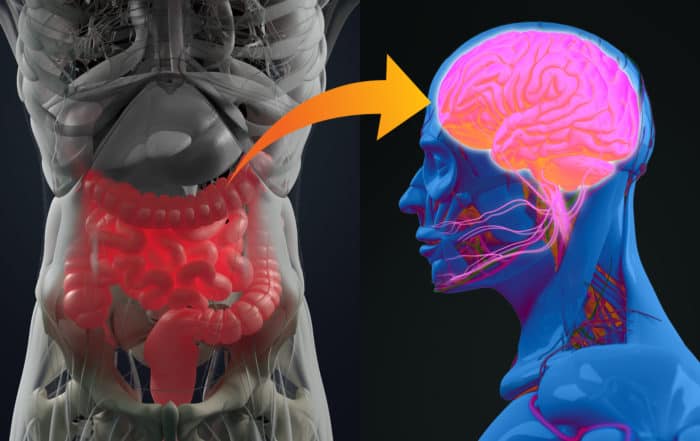
The prevalence of co-occurring gastrointestinal (GI) issues in autism ranges from 9 to 91%, with constipation being the most common (1:30). Research shows that many autistic people have a heightened stress response which activates the sympathetic nervous system – fight or flight mode – and inhibits stomach function. Ferguson and his team look at GI issues through a stress lens, suggesting that activation of the sympathetic nervous system is related to a lot of GI issues (3:00). He outlines past work that shows a positive relationship between levels of cortisol, a stress marker, and constipation (4:30). Similar work shows that having co-occurring anxiety significantly altered parasympathetic nervous system activity in the lower GI tract, meaning that anxiety is related to GI symptoms in autism (5:40).
In a 2019 study, Ferguson and colleagues used caregiver questionnaires for 340 autistic children and adolescents to assess correlations between GI conditions and behavior issues (6:30). Results showed that across all ages, 65% experienced constipation, 50% experienced stomach aches, 29% experienced diarrhea, and 23% experienced nausea, where 53% were taking medications for other conditions (ADHD, seizures), and 93% were not taking any GI meds (9:30). In children between the ages of 1 and 5, nausea significantly predicted aggression. Ferguson says that this correlation is likely to do with the children’s inability to communicate their nausea, which leads them to act out. In participants between 6 and 18 years old, anxiety, withdrawn behavior, and somatic complaints were 11% more likely to experience aggression, stomachaches, and nausea, respectively, and less likely to experience certain other GI symptoms (10:55).
The speaker summarizes research findings to date, highlighting that non-verbal young children may use aggression to communicate somatic complaints and that older children have more internalizing behaviors associated with GI symptoms.
Associations between cytokines, endocrine stress response, and gastrointestinal symptoms in autism spectrum disorder (Ferguson et al., 2016)
Psychophysiological Associations with Gastrointestinal Symptomatology in Autism Spectrum Disorder (Ferguson et al., 2016)
The Relationship Among Gastrointestinal Symptoms, Problem Behaviors, and Internalizing Symptoms in Children and Adolescents With Autism Spectrum Disorder (Ferguson et al., 2019)
Electrodermal activity and problem behavior
Electrodermal activity, or skin sweat, is part of the stress response triggered by the sympathetic nervous system. Using a smartwatch, researchers were able to track skin conductance (sweat) from baseline to post-behavior levels (13:13). Results showed a rise in sweat about 60% of the time prior to a problem behavior occurring and a return to baseline afterward about 45% of the time. The average rise in skin conductance before a behavior was around 10 minutes (15:15).
Examining the Association Between Electrodermal Activity and Problem Behavior in Severe Autism Spectrum Disorder: A Feasibility Study (Ferguson et al., 2019)
Treating the stress response
Ferguson and his team assessed a trial of propranolol, a beta blocker (blocks stress response), in children and youth with autism. Results showed a significant reduction in anxiety for the propranolol group compared to controls (17:20). He outlines an fMRI study on the relationship between GI issues and amygdalar activity. The study revealed that participants taking propranolol (which crosses the blood-brain barrier) showed a neutral relationship between GI symptoms and amygdala activity. In contrast, those taking nadolol (which does not cross the blood-brain barrier) or a placebo showed a positive correlation. Ferguson explains that these findings indicate that propranolol is blocking the stress response, which may be related to GI issues (19:25). Future research will include transcutaneous vagus nerve stimulation (tVNS) to test the effect of parasympathetic nervous system (rest and digest) activation on GI symptoms (23:45).
Ongoing work
The research outlined to this point has been strictly lab-based, and the speaker highlights the need for real-world “ecological” monitoring of stress behavior. Lab studies are often stressful in and of themselves, so they may not reflect real-world functioning. Ferguson’s ongoing study, funded by ARI, aims to examine differences in verbal social communication data from 30 autistic people with GI symptoms and 30 without over a three-week period. Data will be collected using smartwatches that track pulse-rate variability, or the time variation between heartbeats, measured with photoplethysmography (PPG). Researchers will also examine differences in autonomic nervous system functioning in relation to GI symptoms (25:30).
Verbal and social activity will be recorded on a smartwatch app that Ferguson and his team developed called “CORE Autism (31:47).” The app measures the total time spoken by a participant. It has reached 90% agreement between what researchers hear and what the algorithm hears (35:35). The speaker underscores the importance of real-world data and how much we miss with typical laboratory-based questionnaires. Researchers hypothesize that pulse rate variability will be significantly lower for the group with GI issues, indicating a higher stress response. They also hypothesize that there is less social communication among the GI group, possibly due to increased stress (36:48).
Ferguson emphasizes that findings from this study will provide real-world evidence of stress and sociability, allowing a potentially different take on the connection between GI issues and stress for autistic people. For example, if stress is heightened in the GI group, implications for treatment could be huge. The presenter notes that more research could be done to address what happens to GI symptoms when stress is addressed and vice versa (37:45). This study will be finished in 2026.
Summary
Ferguson reviews the presentation, highlighting that GI symptoms like constipation are prevalent in autism and often associated with stress response and internalizing behaviors, which may differ by age. The stress response may also precede problem behaviors in autism, providing treatment options based on stress reduction via pharmacological, vagal, and behavioral avenues. While preliminary data are exciting, more research is needed in these areas (39:35). Ferguson provides thanks and acknowledgments before the Q&A, where he discusses enteroception, SSRIs, nutrition, smartwatch usage, and more (42:00).
Originally published November 19, 2024
About the speaker:
 Dr. Bradley Ferguson, PhD is an Assistant Research Professor, MU School of Medicine. He is currently studying the association between immune, endocrine, and psychophysiological markers of stress and gastrointestinal disorders in those with autism spectrum disorder. He is also leading the psychophysiological biomarker assessment for predictors of response to medications, and also the relationship to aberrant behaviors.
Take the knowledge quiz
Can’t see the quiz below? Take it online HERE
2026 Research Updates: GI Symptoms & Behavior
Free webinar at 1:00 p.m. Eastern time (US), December 2, 2026 Dr. Bradley Ferguson, PhD, a 2024 research grant recipient, will share emerging research on the interaction of GI symptoms and behavior in autism.

Research Updates: Gastrointestinal Issues and Autism
Free webinar at 1:00 p.m. Eastern time (US), July 29, 2026 Harland Winter, MD, will discuss his research on gastrointestinal conditions in individuals with autism. Dr. Winter is an active investigator and educator
Managing Digestive Issues and Constipation in Autism
Free webinar at 1:00 p.m. Eastern time (US), April 1, 2026 Learn about evidence-based, effective nutritional strategies to manage constipation. About the speaker: Kelly

Autism Health and Nutrition
Kelly Barnhill, MBA, CN, CCN, discusses nutrition in autism based on recent publications. She outlines research updates on amino acid patterns, probiotics, and dietary interventions, underscoring both what we know and what we

Autism and Gastrointestinal Comorbidities – Research Updates
Mojdeh Mostafavi, MD, describes gastrointestinal conditions commonly seen in individuals with autism, including gastroesophageal reflux disease (GERD), inflammatory bowel disease (IBD), Eosinophilic GI disease (EGID), avoidant/restrictive food intake disorder (ARFID), disorders of

Research Updates: GI Symptoms & Behavior
Dr. Bradley Ferguson, PhD, a 2024 research grant recipient, discusses emerging research on the interaction of GI symptoms and stress in autism. He outlines recent investigations highlighting the connection between GI