

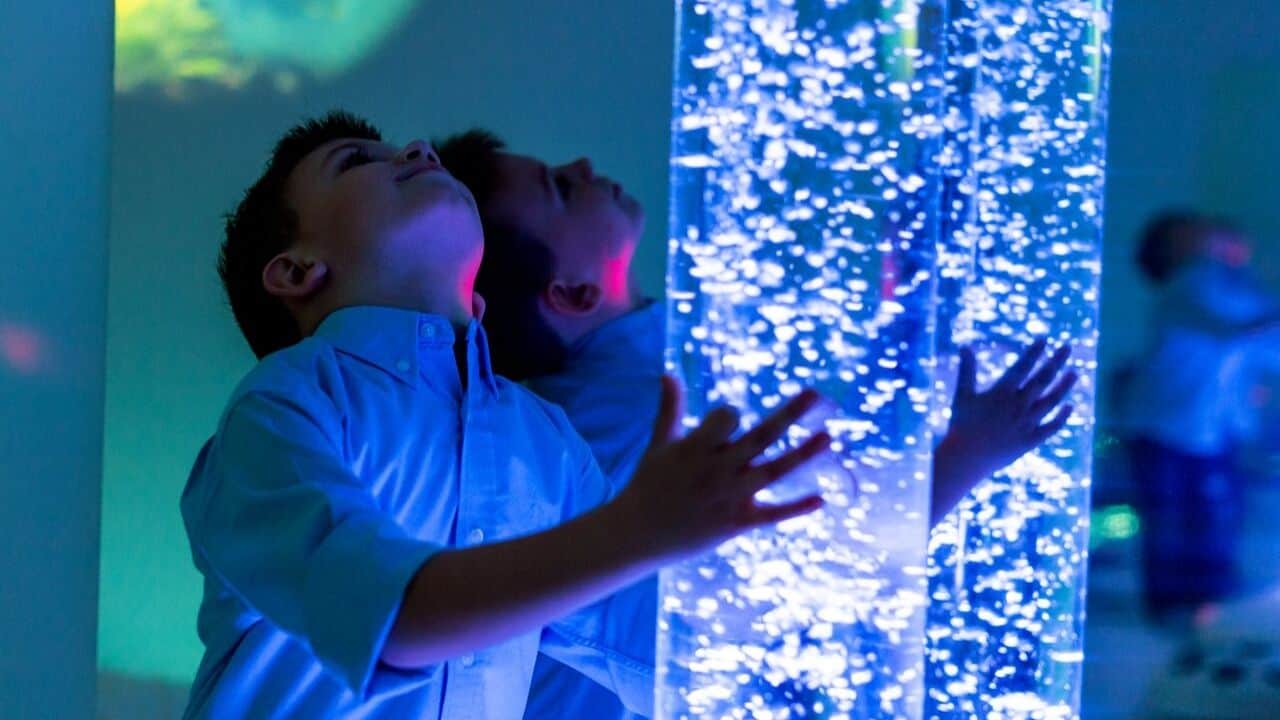
Individuals with autism spectrum disorders (ASD) often exhibit anomalies in visual processing, and a new study indicates that alterations in the activity of the neurotransmitter GABA may play a role in these issues.
Qiyun Huang and colleagues analyzed electroencephalogram (EEG) recordings from 44 adults, 19 of whom had ASD. The researchers focused on the activity of the occipital lobe—the region of the brain that processes vision—in response to a series of visual stimuli with high and low contrast. EEGs were performed with and without the administration of a drug called arbaclofen, which switches on GABA type B receptors.
The researchers found that for non-autistic adults, 30 milligrams of arbaclofen disrupted visual processing. In individuals with ASD, however, the same dose of arbaclofen caused visual processing to become more like that of the non-autistic group at baseline.
Huang says, “We have known for some time that the GABA pathways in the brain might play a role in the way autistic people process visual information and the behaviors that rely on this information. What we have in this study is the first direct evidence that a specific visual response in the human brain is regulated by GABA, but quite differently in neurotypical and neurodiverse individuals.”
The researchers say their findings, while preliminary, suggest that arboclofen may help to alleviate visual symptoms in individuals with ASD.
—
“GABAB receptor modulation of visual sensory processing in adults with and without autism spectrum disorder,” Qiyun Huang, Andreia C. Pereira, Hester Velthuis, Nichol M. L. Wong, Claire L. Ellis, Francesca M. Ponteduro, Mihail Dimitrov, Lukasz Kowalewski, David J. Lythgoe, Diana Rotaru, Richard A. E. Edden, Alison Leonard, Glynis Ivin, Jumana Ahmad, Charlotte M. Pretzsch, Eileen Daly, Declan G. M. Murphy, and Gráinne M. McAlonan, Science Translational Medicine, Vol. 14, No. 626, January 5, 2022 (online). Address: Grainne M. McCalonan, [email protected].
—and—
“New study demonstrates link between brain chemical and visual processing in autism,” news release, King’s College London, January 5, 2022.
This article originally appeared in Autism Research Review International, Vol. 36, No. 1, 2022

Editorial: What we breathe matters – Rethinking air pollution and autism
For nearly sixty years, the Autism Research Institute (ARI) has tried to understand autism by looking beyond surface behaviors and asking deeper biological questions. From the beginning, Bernard Rimland challenged the dominant
Editorial: Invisible threats – the role of environmental toxins in autism
As our knowledge about autism continues to evolve, so does our understanding of its root causes. For many years, professionals blamed “refrigerator parents” and prescribed psychoanalytic therapy. Once the psychogenic theory was
ARI’s 2025 Impact
Advocating for Independent Research and Education For nearly six decades, ARI has funded groundbreaking research, expanded educational initiatives, and brought clinicians and scientists together worldwide. Yet researchers and clinicians continue to face unprecedented