

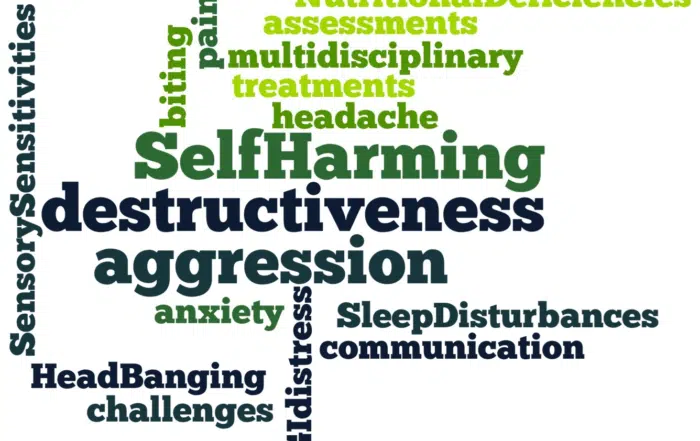
Emily Ferguson, Ph.D., discusses self-regulation strategies for self-injurious behaviors (SIB). She outlines recent research on the frequency and distribution of different SIBs across a large sample, underscoring the importance of assessing individual behavior severity instead of an overall SIB score. The presenter considers the role of emotion regulation in SIB interventions. Ferguson considers emotion recognition, coping strategies, and prevention methods and provides free online resources for parents and clinicians.
In this webinar:
2:25 – Self-injurious behavior and autism
7:20 – Study: Frequency and distribution of unique SIBs
10:30 – Results
17:25 – Summary
19:45 – Helpful questions
22:20 – Adult self-reports
24:12 – Dialectical behavior therapy (DBT)
27:00 – Emotion regulation (ER) and challenging behaviors
30:45 – Emotion recognition and ER strategies
33:55 – Prevention
39:30 – Resources
42:40 – Q&A
Self-injurious behavior and autism
Ferguson explains that self-injurious behaviors (SIBs) are present in 40 – 50% of autistic people. They often persist in varying forms and intensities across the lifespan and significantly increase the likelihood of tissue damage or physical injury, hospitalization, and more restrictive residential placements (2:25). Common forms of repetitive behaviors include head-banging, skin-scratching, self-hitting, hair-pulling, lip or cheek-biting, nail-biting, skin-picking, and hitting against hard objects. Research shows that lower speech production, lower cognitive functioning, greater emotion dysregulation, greater sensory sensitivity, sex, and age are all linked to greater severity of SIB (6:30). The presenter notes that measurements and conceptualization of SIB vary across studies (5:25).
Frequency and distribution of unique SIBs
The speaker outlines her recent publication on the frequency and distribution of unique SIBs across a large sample. The study uses 593 survey responses to explore speech level, cognitive function, emotion dysregulation, and sensory sensitivities for each of the eleven most common non-suicidal SIBs (7:20).
Roughly 30-50% of caregivers reported mild to severe concerns for many types of SIB, highlighting the importance of looking at severity for every kind of SIB instead of an overall score. Results show that higher emotion dysregulation, or difficulty managing, responding, or calming strong emotions, was significantly associated with greater severity of nine types of SIB ranging from self-hitting to skin-picking (10:30). Higher sensory hypersensitivity was associated with greater severity of self-scratching (with and without tissue damage), repetitive hair-twirling, and skin-picking and lip-biting (with and without tissue damage). Ferguson asserts these findings indicate that these types of SIB may be a means of self-soothing or communicating distress in response to overwhelming sensory stimuli (13:30).
Self-scratching, self-hitting, and lip-biting (with tissue damage) were significantly associated with lower IQ, suggesting that the presence of intellectual disabilities (ID) might increase the risk of engaging in specific types of SIB. The study also found that youth who speak in full sentences demonstrate lower severity of self-hitting and head-banging than youth who use no words to communicate. Ferguson reiterates that self-hitting and head-banging may be a way of communicating, especially for autistic people with ID who are non-verbal (15:45).
She summarizes research findings, reiterating the important insights we can gain by examining the severity of unique types of SIB rather than their overall occurrence. She notes that head-banging and self-hitting can result in serious physical harm, posing a greater risk to those with lower IQs and speech ability (17:25).
The speaker suggests asking these questions to help determine causes and care strategies for SIB (19:45):
- Is the situation placing demands that exceed ER skills? (Adaptive emotion regulation (ER) skills)
- Is the behavior in response to unmet sensory needs or sensory overload? (Sensory dysregulation)
- Are the demands on the individual too high or low for their cognitive level? (Cognitive capacities)
- Does this person have a functional way to communicate? (Adequacy of communication system)
- Exploring the Heterogeneity of Self-Injurious Behaviors in Autistic Youth: Patterns, Predictors, and Implications for Intervention (Ferguson et al., 2025)
Adult Self-Reports
The presenter outlines a recent study by Moseley and colleagues that asked autistic adults about the perceived role of non-suicidal SIBs (a more extensive list than the previous study). Participants reported hurting themselves in order to feel something, change emotional pain into something physical, relieve stress or pressure, deal with frustration, shock or hurt someone, self-punishment, and to prevent hurting themselves in other ways (22:20).
- A ‘choice’, an ‘addiction’, a way ‘out of the lost’: exploring self-injury in autistic people without intellectual disability (Moseley et al., 2019)
Dialectical behavior therapy (DBT)
Dialectical Behavior Therapy (DBT) was developed for people with borderline personality disorder but can be applied to people across the spectrum of life. DBT is often a first-line treatment for people who engage in SIB or have suicidal thoughts or tendencies. It works to identify and distinguish repetitive behaviors, accepting the ones that serve a good purpose while changing others that increase the risk of harm to self or others (24:21).
Emotion regulation and challenging behaviors
The speaker outlines the pathway from difficulties with ER to challenging behavior presentation and considers the role that self-regulation has in SIB interventions (27:00):
Individual factors (hungry or tired) → precipitating cues (loud/surprising noise) → difficulty identifying and labeling emotions (overwhelmed) → negative experience continues or increases (no coping strategy) → challenging behavior is expressed.
Emotion recognition
Emotion recognition can be difficult for everyone, and creating a personalized feeling chart can significantly help. Ferguson discusses how to make a feeling chart that captures the sounds and feelings of one’s emotions as well as what someone needs in those moments (30:45).
Emotion regulation (ER) strategies
ER strategies include coping skills and co-regulation techniques, which the speaker suggests should be practiced daily. For caretakers, it is essential to do these things with their child or patient to model effective coping strategies. Ferguson highlights the benefits of parent skills training and provides a free training video that teaches some quick coping skills for calming down and returning to a place where you can work through problems and big emotions more effectively (31:40).
Prevention
SIB prevention techniques focus on reducing the likelihood of distressing situations or contexts. If an SIB consistently occurs in a specific location, consider what about that place may cause distress to you or your child. It’s also helpful to note setting events, like sleep, that can affect irritability and ER throughout the day (33:55). The Research Units in Behavioral Intervention (RUBI) provides free online materials to help with SIB prevention.
Functional behavior analyses of problem behaviors are commonly used to identify antecedents, behaviors, and consequences and can help identify positive and negative communication cycles. Ferguson emphasizes that behavioral approaches must be strengths-based and aimed at reducing negative impact. Other prevention methods include mental health therapies and parent training in behavior management, as outlined in the RUBI resources and Parent-Child Interaction Therapy (ages 2 – 7) (35:55). The speaker shares a clinical guide for treating severe behaviors, toolkits, and ECHO training (39:30) before the Q&A (42:40).
Resources provided during the talk and in text:
- Article by Dr. Ferguson mentioned in the talk: https://onlinelibrary.wiley.com/doi/full/10.1002/aur.3269
- ECHO Autism Challenging Behavior: https://echoautism.org/challenging-behavior/
- Autism Speaks Challenging Behavior Toolkit: https://www.autismspeaks.org/tool-kit/challenging-behaviors-tool-kit
- RUBI intervention online materials: https://academic.oup.com/book/1248/chapter/140180019
- Moseley article referenced during the talk: https://link.springer.com/content/pdf/10.1186/s13229-019-0267-3.pdf
Originally published December 3, 2024.
About the speaker:
 Emily Ferguson, Ph.D., is a postdoctoral academic researcher and clinician within Stanford University’s Autism and Developmental Disorders Research Program within the Department of Psychiatry and Behavioral Sciences. She earned her doctoral degree in Clinical Psychology from the University of California Santa Barbara and completed her clinical internship at the University of California Los Angeles. Dr. Ferguson’s research focuses on advancing understanding of mechanisms of challenging behaviors in autistic youth and adults to inform treatment development. Her work takes a comprehensive perspective, integrating methods from implementation science to improve the accessibility and quality of clinical care for underserved autistic populations, especially those with higher support needs (or “profound autism”). She is also interested in developing methods to improve self-regulation in individuals with profound autism to effectively manage self-injurious behaviors and aggression. Dr. Ferguson is currently supporting research in the Preschool Autism Lab, and exploring profiles of challenging behaviors with the Program for Psychometrics and Measurement-Based Care in a diverse range of autistic and non-autistic youth to inform treatment approaches.
Take the knowledge quiz
Can’t see the quiz below? Take it online HERE
Self-Regulation Strategies for Self-Injury
Emily Ferguson, Ph.D., discusses self-regulation strategies for self-injurious behaviors (SIB). She outlines recent research on the frequency and distribution of different SIBs across a large sample, underscoring the importance of assessing individual behavior
Understanding and Treating Autism: Book Series
A new book, titled Understanding and Treating Sleep Disturbances in Autism, is now available from Jessica Kingsley Publishers. The book is edited by ARI's chief science officer, Stephen M. Edelson, and past
Understanding and Treating Self-Injurious Behavior in Autism
Pictured: Editors Stephen M. Edelson and Jane Botsford Johnson A comprehensive, authoritative resource on understanding and resolving self-injurious behavior (SIB) in people with autism and related conditions with contributions by top
Understanding and Treating Anxiety in Autism
Pictured: Editors Stephen M. Edelson and Jane Botsford Johnson Understanding and Treating Anxiety in Autism, is now available from Jessica Kingsley Publishers. The book is edited by ARI's executive director, Stephen M.

Depression In ASD: Insights From A Network Analysis
Depression as co-occurring condition in autism is frequently reported, but there is not a consensus on the risk factors. Tune in to learn about recent research on the

Self-Injurious Behavior – Anxiety and OCD
Watch Dr. Moskowitz’s previous talk on positive strategies for addressing anxiety and OCD, HERE References in the playback above include: Three methods of saying "no" without escalating: HERE Treatment when