

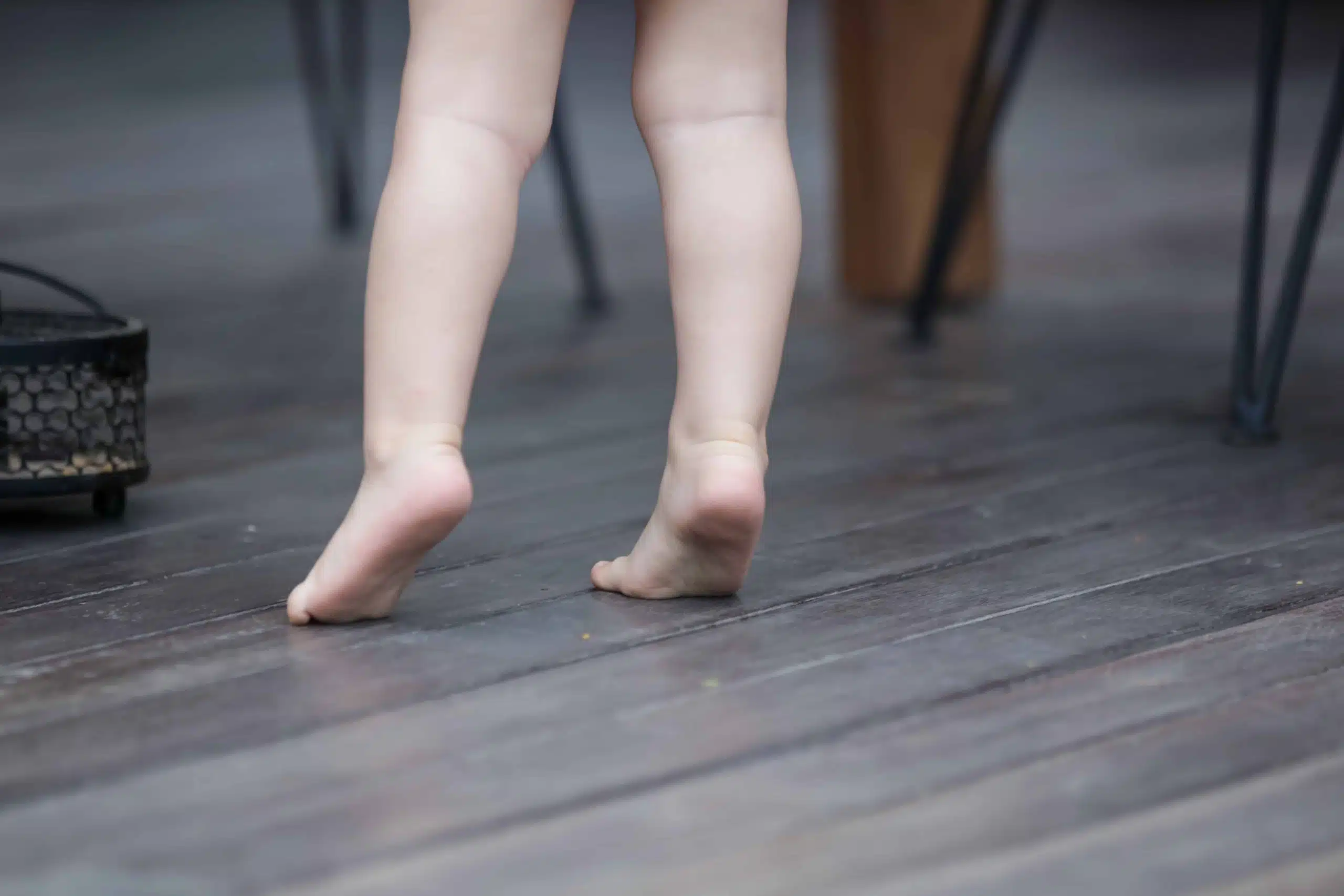
Toe walking refers to a gait cycle/walking pattern in which the heel does not contact the ground; this is a common developmental variation in young children (aged three and under) and generally isn’t cause for concern as it will typically regress without intervention. (Morozova et al., 2017). If toe walking persists beyond age three, it may be an early symptom of an underlying developmental condition. Persistent toe walking may also indicate short or tight Achilles tendons, cerebral palsy, or, in rare cases, muscular dystrophy (Engström and Tedroff, 2018; Leyden et al., 2019). However, toe walking is not always a sign of an underlying condition.
Relation to Autism
Idiopathic toe walking (toe walking that persists without a diagnosed neuro-motor or physical dysfunction) is most frequent in children with neuropsychiatric and communication and learning conditions (Sala et al., 1999; Engström and Tedroff, 2018). Studies on the prevalence of idiopathic toe walking did not differentiate between ASD and other neuropsychiatric conditions until recently. However, in 2019 a large-scale review of trends and treatment patterns found that 9% of children with ASD are diagnosed with persistent/idiopathic toe walking compared to less than 0.5% of children without an autism diagnosis (Leyden et al., 2019).
Causes for this increased prevalence of toe walking in individuals on the spectrum are varied and unclear. In some cases, it results from tight heel cords that restrict the range of movement in the ankle (Barrow et al., 2011). Toe walking can also be caused by a dysregulated vestibular or sensory system involving touch, proprioception, and vision. More research is needed to fully understand which tactile/sensory processing differences may cause idiopathic toe walking in children with ASD.
The long-term effects of toe walking are not fully understood. Some studies affirm a connection between toe walking and secondary shortened Achilles tendons or other biomechanical changes which can limit the range of motion in the feet and ankles (Valagussa et al., 2018; Mulkin et al., 2006). Others assert that issues with toe walking are purely cosmetic and have no long-term adverse physical effects (Dietz and Khynsree, 2012).
Available Treatments
There are several treatments available that can reduce or eliminate toe walking. Before starting a therapeutic regimen, we advise that you seek information on available treatments and their long-term effectiveness. Some interventions lack clinician support and significant evidence of efficacy and no single treatment has demonstrated extensive long-term success (Williams et al., 2020; Caserta et al., 2019).
Treatments for toe walking in a child with autism include:
- Physical therapy – A physical therapist works with the child on stretching the leg and foot muscles; this can help release tension and increase range of motion (de Oliveira et al., 2019).
- Prism Lenses – An optometrist with expertise in vision training may prescribe ambient prism lenses. These lenses help improve one’s perception of where one’s body is relative to their surroundings.
- Vestibular Stimulation and Sensory Integration – A physical or sensory therapist may recommend that your child swing, spin, or engage in other actions that stimulate the vestibular system.
- Leg braces or splints – A physician may prescribe a leg brace or splint to help promote contact between the heel and the ground.
- Serial Casting – A physician may apply a series of below-the-knee casts to progressively adjust the foot’s position (Fox et al., 2006).
- Surgery – A surgeon may lengthen the muscles or tendons in the back of the lower leg. This option is usually only recommended when other therapies have failed (Eastwood et al., 2000).
As stated, toe walking is generally not a cause for concern in children under three years of age. If your child is older and regularly toe walks, consider consulting your child’s pediatrician. They may perform an assessment or refer your child to a specialist to determine which course of action (if any) to take. It is essential to work closely with your care team when deciding if/how to treat your child’s toe walking.

Nutritional Neurobiology of Autism: Revisiting the Zinc Hypothesis
Free webinar at 1:00 p.m. Eastern time (US), May 13, 2026 Recent data support a model in which altered zinc biology may act as a modifiable risk factor within

Managing Digestive Issues and Constipation in Autism
Free webinar at 1:00 p.m. Eastern time (US), April 1, 2026 Learn about evidence-based, effective nutritional strategies to manage constipation. About the speaker: Kelly

COMPASS: A Caregiver–Teacher Partnership Model for Improving Outcomes in Autistic Children and Youth
The Collaborative Model for Promoting Competence and Success (COMPASS) is an evidence-based consultation framework designed to enhance outcomes for autistic children and youth by strengthening caregiver–teacher partnerships. Developed by

Evidence That Speaks: Prioritizing Proven Communication Supports for Non-Speaking Autistic Children
Connie Kasari, PhD, details what contemporary research reveals about supporting non-speaking or minimally verbal autistic children. She highlights how far the field has come in the past two decades and emphasizes the

Caregiver Strategies for Building Infant Social Interaction
Laurie A. Vismara, Ph.D., BCBA-D, R.B.A. (Ont.) details caregiver strategies for building infant social interaction. She introduces the Infant Start Manual, an extension of the Early Start Denver Model. The speaker
Motor Skills and Executive Function in Autism
Megan MacDonald, Ph.D., and Megan McClelland, Ph.D., discuss emerging research on the relationship between motor skill development and executive function in autism. They define motor skills and executive function, discuss their long-term impact